

AS Welding Automation for XXL Sheet Metal Parts [6000 x 2500 mm Working Area]
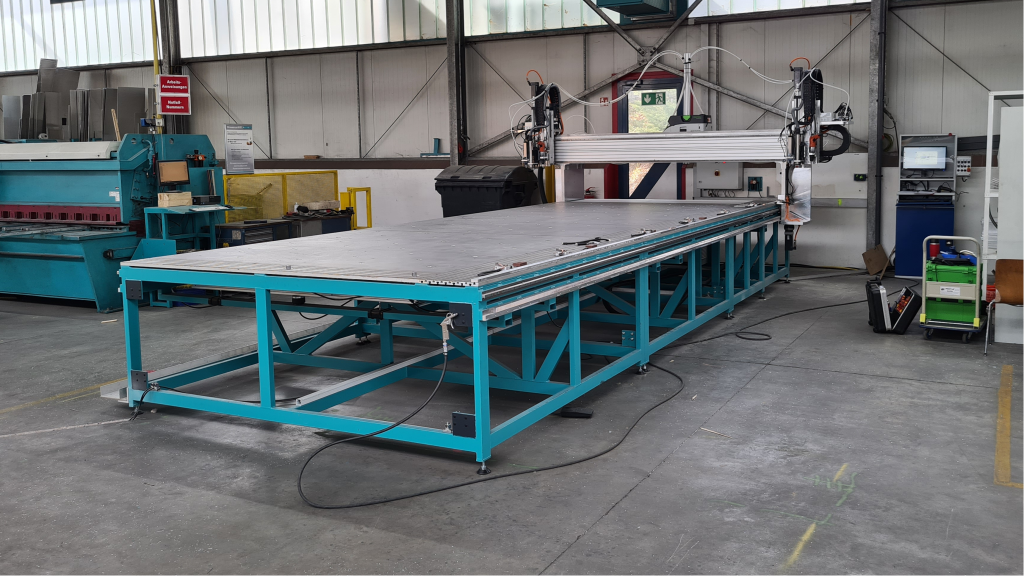
With a working area of 6000 x 2500 mm, this stud welding CNC offers the largest working area for stud welding in sheet metal fabrication to date. This makes it ideal for welding studs onto large facade panels. The workpiece is positioned using workpiece stops and held in place by pneumatic clamping. On this standard system, the workpiece is loaded by the operator. To make it easier to move workpieces on the table, pneumatic ball transfer units are installed, which can be activated and deactivated via a foot switch.
Thanks to its Z-axis, the machine can process both bent and flat sheets. Aluminium, steel and galvanised sheets can all be processed.
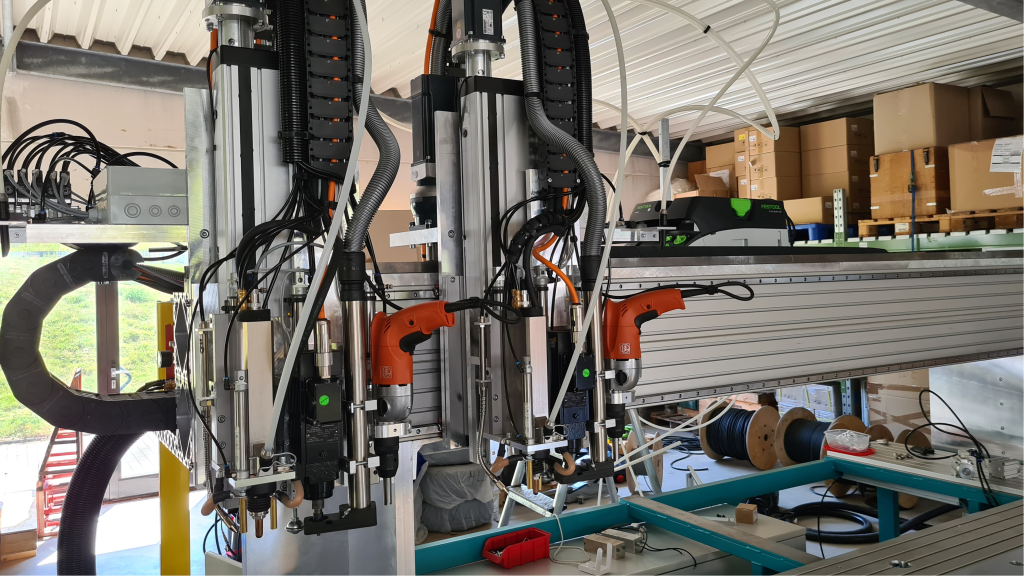
The system is equipped with two AS Ak1 welding heads. This allows two different stud types to be welded onto one workpiece without any changeover time. Alternatively, the two head units can work in parallel with the same stud diameter, which considerably reduces processing time for workpieces with many studs.
In addition to the welding head, each head unit includes a milling cutter and a countersink. The milling cutter is particularly important for aluminium workpieces: in a first step, it prepares the weld location by removing the aluminium oxide layer with minimal material removal. Countersinking, on the other hand, is a downstream step that removes the weld spatter around the weld produced by the tip ignition process. This is also mainly required for aluminium, where the spatter ring is particularly pronounced. A blower is provided to remove the chips.
The system is equipped with two AS 1200 CNC stud welders with weld data monitoring, enabling the welding process to be monitored. Using OK/NOK classification, the system automatically informs the operator if a weld deviates. The data is stored on an SD card. Interfaces such as OPC UA, PROFINET and MQTT are optionally available for weld data monitoring and machine data.
Stud feeding is fully automated and monitored by the new digital VBZ 5100 stud feeding system. Simply pour the studs straight from the bag into the separating unit, and they are automatically separated and fed to the welding head as required by the process.
As such a complex automation system quickly involves many components that would considerably increase programming effort, we offer the AS CAM software with an integrated DXF/STEP post-processor. It is tailored to each automation project and simplifies programming for the user by generating the program automatically. Just a few clicks are needed to define the production parameters, and with the stored workpiece drawing, the machine is ready for operation in seconds.
A special path optimisation algorithm was also developed for this system to make the process as time-efficient as possible. On the one hand, it enables simultaneous welding along one workpiece axis. On the other hand, it determines the shortest possible path and ensures that as many studs as possible are welded simultaneously. For example, head units 1 and 2 can also work alternately, even if the studs are not on the same axis, to minimise process time. The generated programs can be saved automatically to a file system, together with images showing how the workpieces must be placed in the system. Setup instructions for the operator can also be generated.
The system can be operated in automatic and manual mode via the HMI, which can be controlled either by touchscreen or by mouse and keyboard.
The system is also equipped with hold-down devices. These ensure that the welding head is withdrawn cleanly from the stud after welding without lifting the sheet, which is particularly important for large, thin sheets.
