Shielding gas welding is mostly used as an alternative to ceramic ferrule welding for stud diameters up to 12 mm. The shielding gas protects the molten metal from the atmosphere and thus prevents nitrogen absorption, reduces oxidation and avoids porosity. The shielding gas also influences the melting behaviour, resulting in shallower penetration and greater melting at the stud compared to welds with ceramic ferrules.
Depending on stud size and welding time, shielding gas welding requires gas flow rates of around 10 to 20 l/min.
Thanks to our long-proven shielding gas technology, Arnhold stud welders enable you to achieve ideal welding results. With our many years of experience and expert advice on optimal earth connection to avoid arc blow, high-quality welding results can be achieved.
Overall, stud welding with shielding gas produces high-quality and visually appealing welds.
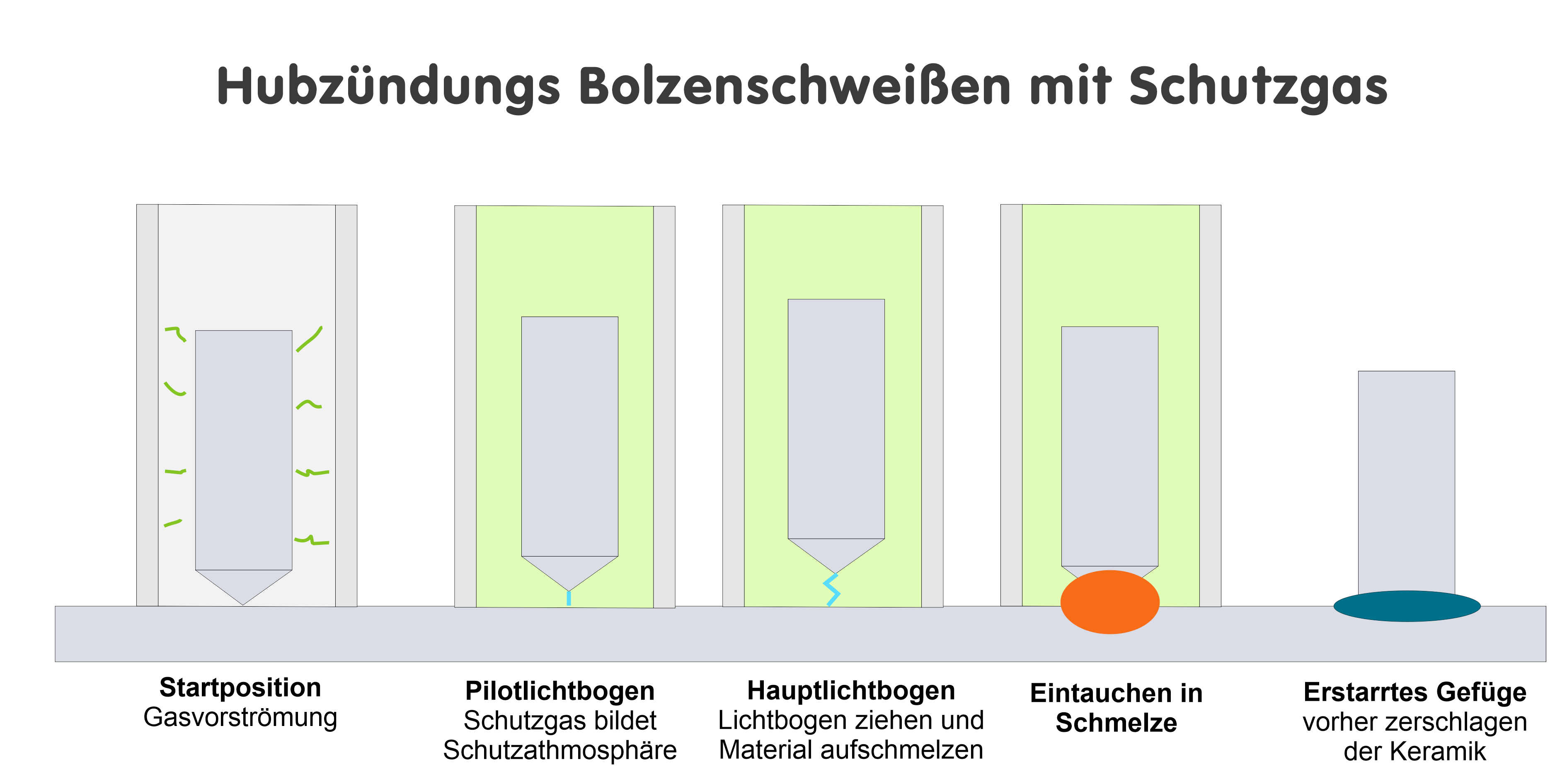
The shielding gas process works as follows:
At the start, the stud sits on the workpiece and is lifted off it. This is also when the gas pre-flow takes place. A pilot arc is first generated with a low current. After a short "holding time", the main arc, which actually melts the materials, is ignited. The shielding gas forms the protective atmosphere. Optimised shielding gas devices, such as those of the AS 2901 or 2902, ensure an even gas flow and thus reduce arc blow caused by the shielding gas.
Throughout the welding process, the stud is thus lifted off the workpiece within the set welding time and, once this has elapsed, plunged into the molten pool of the workpiece. This is where the stud joins the workpiece. The finished weld is available immediately after the device is lifted off.
The result is a firmly welded stud. The graphic shown here illustrates the welding process schematically.